How can existing submarine fibre-optic infrastructure help us listen to the ocean?
As part of the SEAMPHONI project, a team from GREENOV travelled to Madeira for a week-long field campaign hosted and supported by local project partner ARDITI. From 21 to 23 July, the teams carried out three days of measurements at sea, testing the potential of Distributed Acoustic Sensing (DAS) as a tool for monitoring marine environments.
The objective of the campaign was to calibrate and assess DAS technology under real offshore conditions. With the support of EMACOM, the team connected DAS equipment to a submarine optical fibre extending south from Funchal. Measurements collected through the fibre were then compared with reference acoustic measurements taken directly at sea.
Turning an optical fibre into an ocean sensor
Distributed Acoustic Sensing is a technology that can transform optical fibres into continuous arrays of acoustic and vibration sensors. Instead of installing individual sensors at many locations, a DAS interrogator sends laser pulses through an optical fibre and analyses tiny changes in the light returning through it.
For ocean monitoring, this opens up an exciting possibility: using existing submarine telecommunications infrastructure to detect acoustic signals across large marine areas, potentially complementing conventional monitoring methods such as hydrophones and research-vessel surveys.
The Madeira campaign was designed to test that potential in practice.
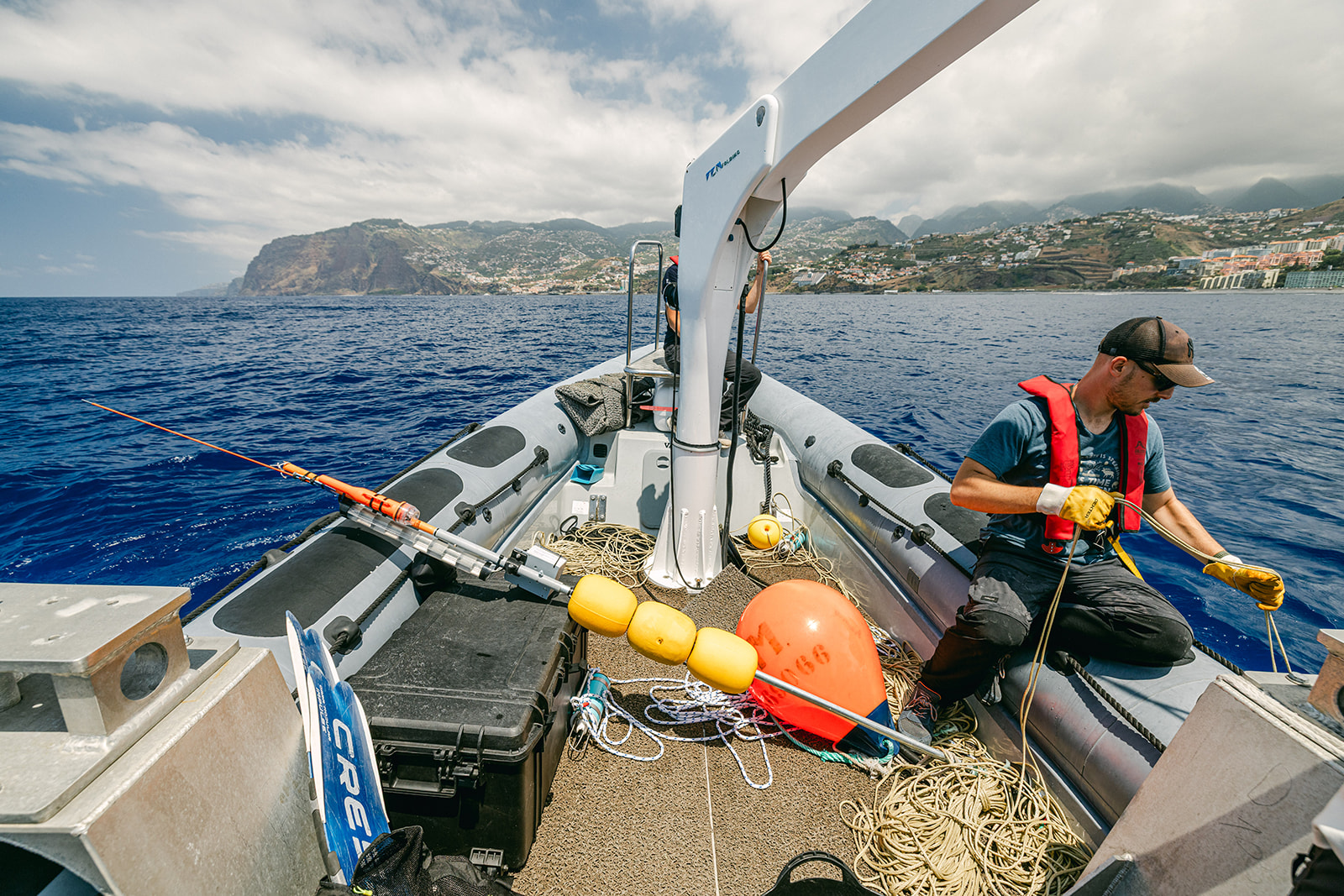
Erwan Meteyer, acoustic expert at GREENOV, joined the offshore operations, where the team deployed a measurement buoy equipped with reference hydrophones and generated controlled acoustic signals from the boat. Meanwhile, Benoit Fuentes, GREENOV's DAS expert, was responsible for setting up the DAS system and carrying out the initial analysis and real-time calibration checks.
The first day of measurements focused on evaluating the performance of ARDITI's DAS interrogator. During the second and third days, the team tested GREENOV's DAS interrogator, carrying out measurements with two different boats.
By comparing the signals recorded through the submarine fibre with those captured by the reference hydrophones, the researchers could assess how accurately the different DAS systems detected underwater acoustic signals and better understand their performance in real marine conditions.
Field validation — with an unexpected visitor
Testing technology at sea also means working in a dynamic and sometimes unpredictable environment.
During the campaign, the team handled buoy deployments, hydrophone measurements and sensor operations from the boats while simultaneously checking and calibrating the DAS measurements on shore.
And in the middle of the technical work came a particularly memorable reminder of what these monitoring technologies are ultimately intended to help observe and protect: a sperm whale surfaced just metres from the measurement buoy.
The encounter offered an unexpected highlight to a campaign centred precisely on finding better ways to observe marine life. ARDITI/MARE-Madeira later shared the sighting, which occurred during the acoustic trials with the SEAMPHONI partners.
From field trials to scalable ocean monitoring
Campaigns like this one are an important part of SEAMPHONI's wider mission.
Offshore biodiversity monitoring currently relies heavily on research vessels and dedicated surveys. These approaches provide essential scientific information, but they are expensive and difficult to operate continuously across the vast areas that need to be understood and protected.
SEAMPHONI is working to change that by testing, combining and validating innovative approaches based on acoustics, environmental DNA (eDNA) and imaging. The ambition is to generate more continuous and scalable observations of offshore biodiversity and bring these different streams of information together within an Intelligent Marine Digital Twin.
DAS could become an important piece of this monitoring landscape. If existing submarine optical fibres can reliably provide information about underwater acoustic activity, they could extend the reach of ocean observation while reducing dependence on repeated vessel-based measurements.
The Madeira campaign therefore represented more than a technology test. By putting different DAS systems side by side with conventional hydrophones under real conditions, the team is building the evidence needed to understand where the technology works, how accurately it performs and how it could complement existing marine monitoring tools.
Each calibration, deployment and comparison brings SEAMPHONI one step closer to its broader goal: making biodiversity and ecosystem health visible in offshore areas where continuous observation remains difficult today.
A collaborative effort
The campaign was made possible through close collaboration between the organisations and people involved.
GREENOV was hosted in Madeira and accompanied during the offshore operations by ARDITI, while EMACOM provided access to the submarine optical fibre and cable landing infrastructure used for the DAS measurements.
GREENOV's Erwan Meteyer led the acoustic work at sea and Benoit Fuentes carried out the DAS setup and initial analysis. Louis David also joined the campaign for part of the fieldwork.
Special thanks go to Ana Dinis, Anita Alessandrini and Afonso Loureiro, as well as to everyone involved in the boat operations and technical support that made the measurements possible.
Field campaigns depend on this combination of scientific expertise, technology, local knowledge and infrastructure. In Madeira, those elements came together for three intensive days of measurements — and another concrete step towards a more continuous, accessible and scalable way of listening to the ocean.
Picture by Louis David